
What the Fascia?

Have you heard of fascia? What is it? Well, fascia is connective tissue that attaches, wraps or separates muscles or other organs from or to each other. It simultaneously holds us together and keeps our individual parts separated.


Here we see the fascia that wraps around a muscle. It actually defines the edges of the muscle, as well as wrapping the individual muscle fibres. The tendon of the muscle is considered fascia, and there's a sheet of fibre that wraps around the bone that is also a form of fascia. These sheets and fibres form connections to other muscles and bones and sheets and fibres all throughout the body.
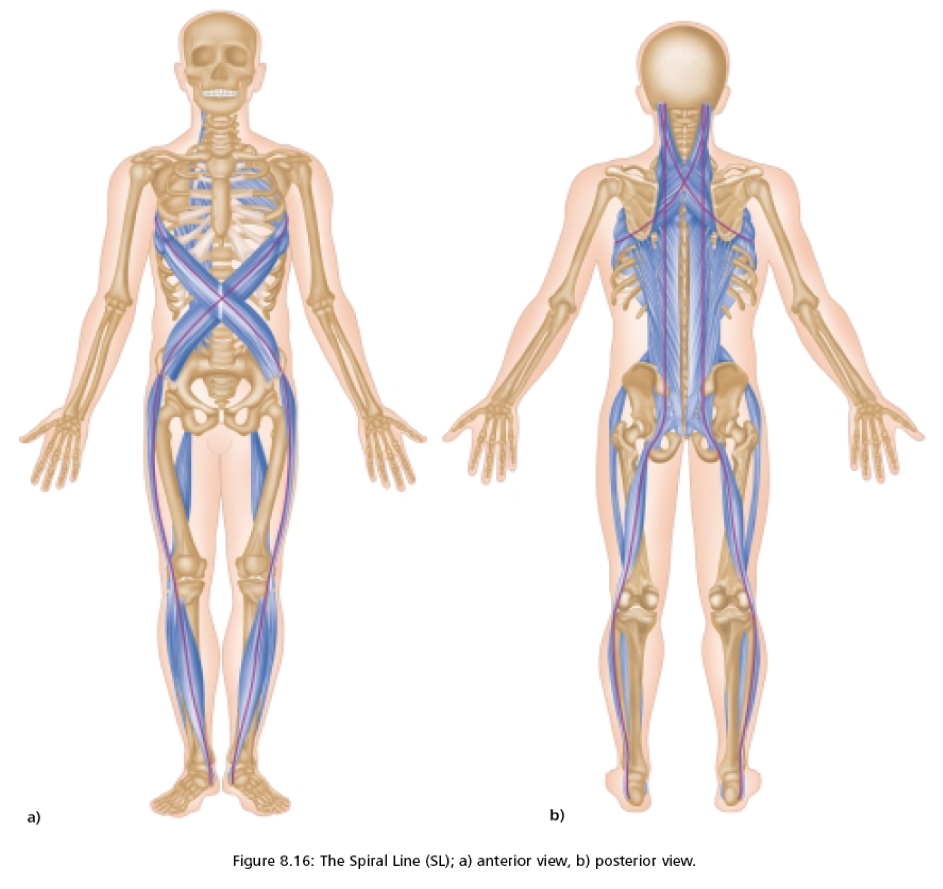
The fascial system is this 3D net of connections throughout the body, that webs and holds all of our bones, muscles and organs together into a continuum. This system interacts very closely with the brain to sense position, to create posture, to stabilise against gravity and other forces, and to create movement. Muscles on their own can contract and tighten, but in truth it's the whole fascial system that regulates muscle tone and holds us upright or in tension. Neurologically, the fascia is sending input to the autonomic nervous system that manages our fight/flight and rest/digest states. The whole system vibrates, like the rigging on a sailing ship, and the unconscious parts of the brain listen to the frequencies of the vibrations and set the whole-body muscle tone from them. Tight, fast vibrating fascia will increase tension throughout the whole body. Slower vibrating fascia will drop tension. This is a really important part of how the human body manages the way that we stand with the majority of our body mass on a single-leg when we're upright.
There's another part to the fascial system though: and that's the Extra-Cellular Matrix (ECM). This is the stuff outside of your muscles and bones and organs, the stuff that fills in the spaces between and sticks them together. For the most part, it's easiest to think of this as a bunch of 'loose threads' that sew all the parts together. Some threads are thicker, some more elastic, but they all weave together in a way that connects while allowing movement.


Here you can see the variety of threads (Reticular, Elastic, Collagen) that weave together into the matrix, and the various cells that swing around the ECM like it's their personal jungle gym. These cells are busily making, dissolving and tensioning the threads as they swing around, and research currently shows that they directly respond to stretch and tension applied through a fascial system massage, and receive signals that help them decide how to reorganise the threads of the matrix as they swing through them.


Filling all the space between the threads is a slippy-slidey jelly called Ground Substance. Ever heard the saying that the human body is 80% water? Well a large portion of that water is held right here. Ground substance is like a sponge, it pulls the water out of the bloodstream and holds it next door to the cells so they can use it. It also gives our tissues weight and substance and resistance to forces like pressure and gravity. Unlike a sponge though, ground substance gets tacky and sticks to itself when there isn't enough water - like if a tight muscle or too-small socks have wrung the tissues empty. Then it works like a viscous glue, holding the tissues together to resist these forces. This is great for stability, but bad for mobility!
Often this glueing is a deliberate unconscious adaptation to a postural position, to take advantage of the mechanical ability of fascia to maintain a position that is staying locked or patterned in place. Oftentimes we'll see it related to a Left AIC and/or Brachial Chain patterning as well. Sometimes the fascia will 'rehydrate' itself when the chronically held muscle tightness has a chance to let go, sometimes both the patterning and the fascial restriction needs to be addressed to fully resolve an issue.